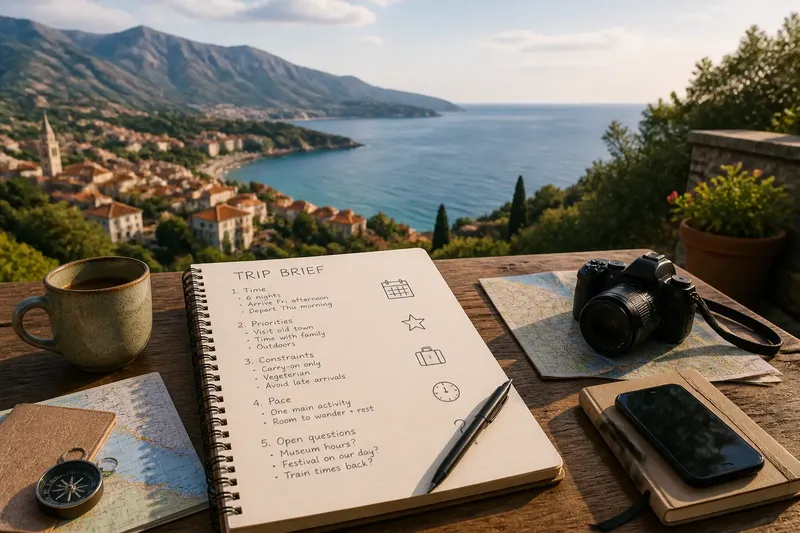
The Packing List That Stops Growing
A packing list tied to planned uses keeps your bag focused on the trip, making it easier to choose what belongs and leave hypothetical extras at home.
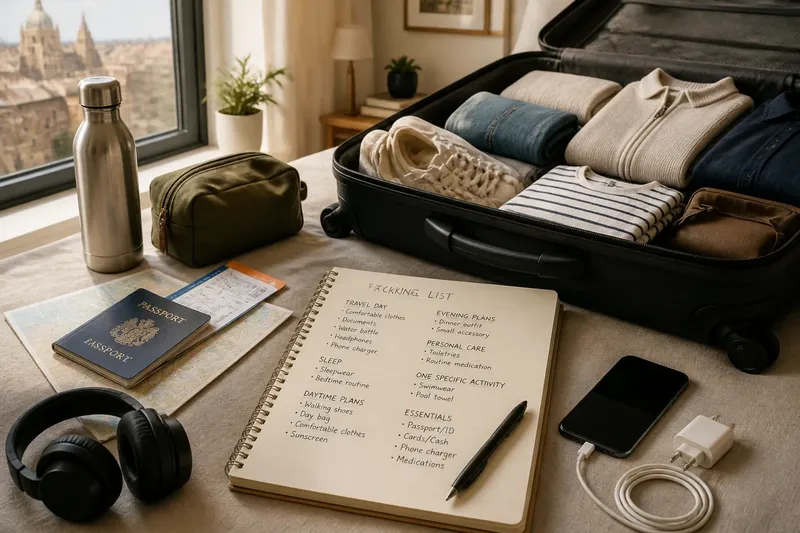
A packing list stops growing when each item has a job on the trip you have actually planned. Instead of adding a gadget or spare outfit for every possible snag, group belongings by planned use: travel day, sleep, walking, evening plans and any specific activity. That simple shift makes a packing list more useful without pretending you can predict every change.
The aim is not to pack as little as possible. It is to make each choice traceable to a real part of the itinerary, while leaving room for ordinary changes in comfort and routine. If an item has no clear role, pause before adding it.
Why do packing lists keep growing?
Many lists begin with the trip, then quietly turn into a catalogue of imagined problems. A second pair of shoes might be added for an outfit you may not wear; a bulky accessory for weather that is not in the forecast; a collection of specialist items for an activity that is only a vague possibility.
Each addition sounds reasonable on its own. The difficulty is that the list has no boundary. A hypothetical need can always produce another hypothetical solution, and the bag begins to reflect anxiety rather than the itinerary.
There is also a difference between preparing for a likely change and preparing for every conceivable one. A light layer may serve cool evenings and an air-conditioned train. A duplicate object kept solely for an unlikely inconvenience may have no useful role at all. Ask what part of the trip calls for the item, not merely whether you can imagine needing it.
What counts as a planned use?
A planned use is a clear occasion or routine on the trip: walking between accommodation and a station, sleeping, visiting a museum, swimming at a booked pool, or taking medication that is part of your usual routine. It need not be an event with a ticket. Meals, washing and the journey itself are real uses too.
Start with the itinerary you have, rather than building an elaborate scenario around it. Note the main settings and activities, then group items under the ones they serve. For a city break, those groups might be travel day, daytime walking, evening meal, sleep and personal care. A coastal stay could include beach time, but only if it is genuinely part of the plan.
Some items serve several groups. A comfortable cardigan might work on the train, in a cool restaurant and at the accommodation. That versatility is a sound reason to pack it; it is not a reason to add every other item that could also serve multiple purposes. Consider whether the item fits the clothes and activities you have already chosen.
How can you group items without packing for every possibility?
Use a simple list or a few notes on paper. Give each planned use its own heading, then add only items with a clear connection. Keep shared essentials, such as a phone charger, in a separate group so they do not get lost among outfit choices.
- Travel day: comfortable clothes, travel documents and the items you need within reach.
- Sleep: sleepwear and any personal item you use as part of your ordinary bedtime routine.
- Walking and daytime plans: suitable footwear, day bag and clothing that fits the expected setting.
- Evening plans: a suitable outfit and any small accessory that has a specific use.
- Personal care: the toiletries you actually use, plus routine medication and relevant prescriptions.
- One specific activity: equipment or clothing for an activity that is confirmed or central to the trip.
These headings are prompts, not a universal formula. Combine or rename them to fit your plans. A visit to a gallery does not usually need a separate packing category; it may simply call for comfortable clothes and shoes already listed under daytime plans.
Say you are taking a train to a city, staying with a friend and have one dinner booked. You might put a water bottle and headphones under travel day, walking shoes under daytime plans, and one suitable outfit under the dinner. If you start adding a second pair of formal shoes for an imagined last-minute invitation, ask whether that invitation is likely enough to shape the bag. If not, leave the shoes off and decide later if the plan changes.
How do you decide whether an extra earns its place?
Before adding something, make the reason concrete. Which planned use needs it? Is there another item already on the list that serves the same role? Could you reasonably do without it, borrow it or obtain a replacement at your destination if circumstances change? These questions are not a demand to travel without useful comforts; they help distinguish a real need from an unbounded “just in case”.
Check overlaps as well. Two garments that serve the same setting may both be worthwhile if you expect to wear them, but not merely because each might suit a different imagined mood. For a small item, the decision may be easy. For something bulky or awkward to carry, ask for a clearer connection to the plans.
It is not worth the effort to create a separate list for every possible combination of weather, outfit and activity. Nor do you need to debate each ordinary item at length. Give an item a sensible use, check that it fits with the rest of the list, and move on.
What if plans or conditions change?
A list tied to planned uses should be revisable, not rigid. If the forecast shifts, the accommodation changes, or an activity becomes definite, update the relevant group rather than adding a new layer of precaution to the whole list. Remove items whose original use has disappeared, too.
For uncertain plans, distinguish between a likely variation and a distant possibility. A light rain layer may make sense when you expect to be outdoors and the forecast is unsettled. Specialist equipment for an activity you have not chosen is a different decision. If the activity becomes real, add what it requires then.
Some essentials do not belong to a particular activity. Documents, routine medication and the means to charge a phone may matter across the whole journey. Keep them visible in a separate essentials group. For medicine or equipment with specific handling requirements, follow the product label, manufacturer guidance and applicable travel rules; ask a qualified professional where individual advice matters.
Which packing-list questions help with the last decisions?
Should I pack an item I might need?
Possibility alone is a weak reason to include it. Add the item when it supports a planned activity, a routine you expect to keep, or a likely change that would meaningfully affect the trip.
How many outfits should I list?
Think in terms of the settings and occasions you expect, then choose clothes that can serve more than one of them. Avoid adding an outfit for an event that is only a remote possibility.
What should I do with items that serve several purposes?
Keep them if their uses match the itinerary and they work with the other belongings you plan to take. Multipurpose is useful when it describes real roles, not when it becomes a reason to pack an item without a clear role.
When should I revise the list?
Review it when a meaningful detail changes, such as a booked activity or a different forecast. Make the edit in the relevant group and remove anything that no longer has a job.
How can you keep the list useful on departure day?
Read each group once and picture the occasion it serves. If you cannot name one, either move the item to a more fitting group or leave it off. Then check the shared essentials separately, so a useful general item does not disappear simply because it is not tied to one outing.
Keep the list available on your phone or on paper, but do not treat it as a promise to carry every entry. It is a decision aid. When a plan changes, adjust the list; when nothing has changed, resist reopening it to invent new needs.
A packing list that stops growing is not the shortest possible list. It is one whose contents still make sense when you connect each group to the trip ahead. Use planned activities, daily routines and likely conditions to decide what belongs, and let remote possibilities stay possibilities. That gives you a practical packing list you can adapt without letting it expand every time a new “what if” comes to mind.